The best cure for nervousness is a map. Here is the entire donation journey — every appointment, every needle, every payment — exactly as our donors experience it.
Total commitment: about 2–3 months per cycle. Your active, appointment-heavy window is only about two weeks of that.
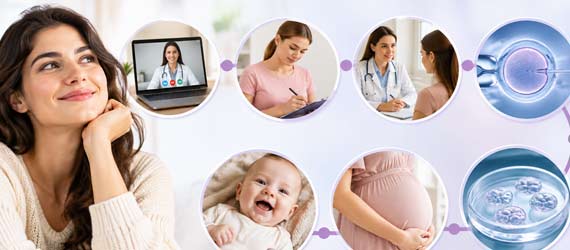
You complete our donor application — health history, family history, lifestyle, photos, and a bit about who you are. Profiles matter to intended parents: the essay questions where your personality shows through are often what makes a family choose you.
A coordinator reviews your application against the core requirements and calls you, usually within a business day.
Your profile becomes visible to intended parents (within your chosen anonymity level). When a family selects you, you confirm the match — it is always mutual — and legal agreements are completed. Your compensation terms are locked in writing before any medication touches your body.
Timing here varies: some donors match within days, most within weeks.
Your cycle is synchronized with the recipient’s (or with a freezing schedule), then stimulation begins:
You arrive at the clinic, receive light IV sedation, and sleep through the entire procedure — no incisions, no scalpels, no stitches. The physician retrieves the eggs with an ultrasound-guided needle, and you wake up in recovery about half an hour later.
Someone drives you home. You rest that day — couch, snacks, someone else’s problems on Netflix — and most donors resume normal life within a day or two, with a short list of temporary precautions the clinic reviews with you. Mild cramping and bloating for a few days is normal; your care team remains a phone call away, and cycle-related complication insurance has been arranged for you throughout.
Your full compensation is released after retrieval per your agreement — regardless of what happens in the laboratory afterward. Your part is complete and fully honored.
Then, three doors:

Egg donation is a process where a woman (the egg donor) provides one or several eggs (also known as oocytes) for purposes of assisted reproduction, with the eggs being fertilized in the laboratory. Once fertilized, the resulting embryos are transferred to the recipient’s uterus to initiate a pregnancy, or they can be cryopreserved (frozen) for future use.
Licensed & Registered: NYS Surrogacy Program License GSP220903 · NYS Tissue Bank License ID 1570 · California Tissue Bank License CTB00082276 · Maryland Tissue Bank License TB3527 · FDA HCT/P Establishment Registration FEI 3021544308 · Health Canada Establishment Registration 000119
Verify: How to check our licenses
Disclaimer: THIS WEBSITE DOES NOT PROVIDE MEDICAL ADVICE AND MAY BE OUT OF DATE. The information, including but not limited to text, PDFs, graphics, images, and other material contained on this website, is for general educational purposes only. No material on this site is intended to be a substitute for professional medical advice, diagnosis, or treatment, and does not create a patient-doctor relationship. Pricing on the website may be out of date, is subject to change without notice, and may be subject to additional terms and conditions. No information on this site is intended to be a financial quote for medical services. Always seek the
advice of your physician or other qualified healthcare provider with any questions you may have regarding a medical condition, lifestyle or dietary changes, treatments, and before undertaking a new healthcare regimen.
Never disregard professional medical advice or delay in seeking it because of something you have read on this website.
© 2026 EggDonors4All. All Rights Reserved.