
The blastocyst stage occurs on Day 5–6 after fertilization and represents a key milestone in embryo development. A blastocyst forms when cells specialize into the inner cell mass (future fetus) and trophectoderm (future placenta). This structure marks the transition from simple cell division to organized development and higher implantation potential. EggDonors4All provides educational guidance only; licensed fertility clinics perform all embryology and IVF procedures.
Forms on Day 5–6
Contains ICM + trophectoderm
Highest implantation potential
Critical for IVF embryo selection
Precedes implantation and gastrulation
The blastocyst stage is one of the most important milestones in human development. Whether you’re learning biology or navigating IVF, understanding this structure helps explain embryo potential, implantation timing, and why many clinics prefer Day-5/Day-6 transfers.
Below is a clear, non-technical guide suitable for intended parents and students alike.
EggDonors4All does not perform any medical procedures; all IVF steps are handled by licensed fertility clinics.
A blastocyst is an embryo that has developed for:
after fertilization.
It is the first point at which the embryo shows cell specialization, meaning the cells begin forming different structures with different jobs.
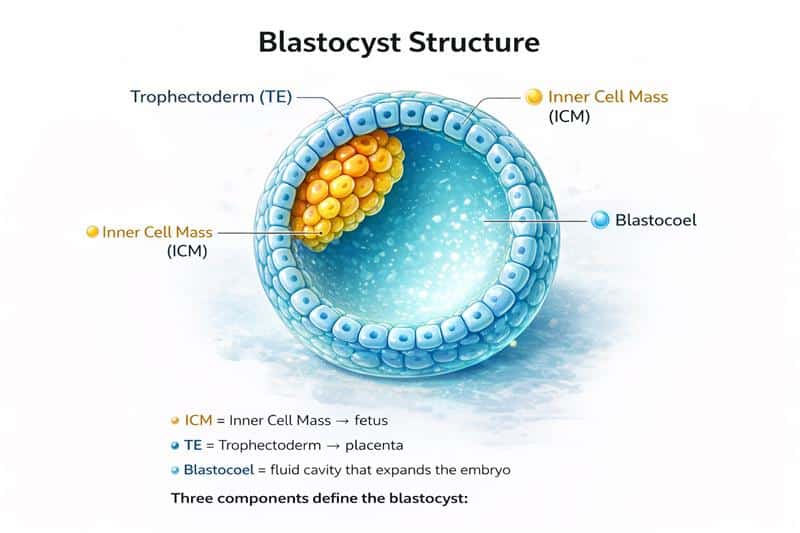
/ \
(TE) | ICM (*) | (TE)
\__________/
ICM = Inner Cell Mass → fetus
TE = Trophectoderm → placenta
Blastocoel = fluid cavity that expands the embryo
Three components define the blastocyst:
1. Inner Cell Mass (ICM)
– Becomes the fetus
– Evaluated in embryo grading
2. Trophectoderm (TE)
– Creates the placenta
– Quality predicts implantation potential
3. Blastocoel
– Fluid cavity that expands as the embryo prepares to hatch
When the blastocyst “hatches” from the zona pellucida, it becomes ready to implant.
Development Stage | Day | Description |
Zygote | Day 1 | Single cell formed after fertilization |
Cleavage Stage | Day 2–3 | Cells divide (2 → 4 → 8 cells) |
Morula | Day 4 | Compact ball of undifferentiated cells |
Blastocyst | Day 5–6 | Differentiated ICM + TE, active expansion |
Implantation Window | Day 6–10 | Blastocyst attaches to uterine lining |
This timeline is used in both fertility clinics and basic biology courses.
Highest implantation potential
Blastocysts have already passed developmental checkpoints that earlier embryos might not survive.
Syncs with uterine timing
The uterus is naturally receptive to implantation around Day-6 to Day-10.
Enables PGT-A biopsy
Blastocysts provide enough trophectoderm cells for chromosome testing.
Compaction (Morula Stage)
Cells become tightly connected, forming inner vs outer layers.
Blastocoel Formation
Fluid enters → embryo expands.
Cell Differentiation
ICM and TE become visible.
Hatching
The embryo breaks through the zona pellucida.
Implantation-ready
This is the point where transfer or freezing typically happens.

Only about 40–60% of embryos reach the blastocyst stage, depending on:
Donor-egg cycles typically show higher survival due to younger egg age.
Term | Definition | Key Feature |
Zygote | Single fertilized cell | Fewest cells |
Blastula | Early animal embryo | Hollow sphere of cells |
Blastocyst | Human version of blastula | ICM + TE + blastocoel |
Gastrula | Post-implantation embryo | Germ layer formation |
The blastocyst is the only stage with ICM and TE, making it distinct.
Grades often look like: 4AA, 5AB, 6BB, etc.
Higher grades suggest stronger implantation potential but do not guarantee outcomes.

Feature | Day-5 | Day-6 |
Reaches blastocyst | Earlier | One day later |
Fresh transfer | Preferred | Less common |
Frozen transfer | Equivalent | Equivalent |
Euploid rate | Slightly higher | Slightly lower |
Normal? | Yes | Yes |
Day-6 does not mean “worse”—many Day-6 embryos produce healthy pregnancies.
The zygote has the fewest—it’s a single cell.
Inner cells → fetus
Outer cells → placenta
Roughly 40–60%, depending on egg age.
Blastocyst = ICM + TE + cavity
Gastrula = germ layer formation after implantation

Guaranteed Blastocyst programs use Day-5/Day-6 embryos because they:
Have the highest predictability
Are best suited for freezing or transfer
Support surrogacy planning
Minimize early-stage uncertainty
EggDonors4All coordinates these programs. All embryology is performed by licensed fertility clinics.
EggDonors4All supports families through donor selection, education, and structured blastocyst-outcome programs.

Egg donation is a process where a woman (the egg donor) provides one or several eggs (also known as oocytes) for purposes of assisted reproduction, with the eggs being fertilized in the laboratory. Once fertilized, the resulting embryos are transferred to the recipient’s uterus to initiate a pregnancy, or they can be cryopreserved (frozen) for future use.
Licensed & Registered: NYS Surrogacy Program License GSP220903 · NYS Tissue Bank License ID 1570 · California Tissue Bank License CTB00082276 · Maryland Tissue Bank License TB3527 · FDA HCT/P Establishment Registration FEI 3021544308 · Health Canada Establishment Registration 000119
Verify: How to check our licenses
Disclaimer: THIS WEBSITE DOES NOT PROVIDE MEDICAL ADVICE AND MAY BE OUT OF DATE. The information, including but not limited to text, PDFs, graphics, images, and other material contained on this website, is for general educational purposes only. No material on this site is intended to be a substitute for professional medical advice, diagnosis, or treatment, and does not create a patient-doctor relationship. Pricing on the website may be out of date, is subject to change without notice, and may be subject to additional terms and conditions. No information on this site is intended to be a financial quote for medical services. Always seek the
advice of your physician or other qualified healthcare provider with any questions you may have regarding a medical condition, lifestyle or dietary changes, treatments, and before undertaking a new healthcare regimen.
Never disregard professional medical advice or delay in seeking it because of something you have read on this website.
© 2026 EggDonors4All. All Rights Reserved.