
AI SMART SUMMARY
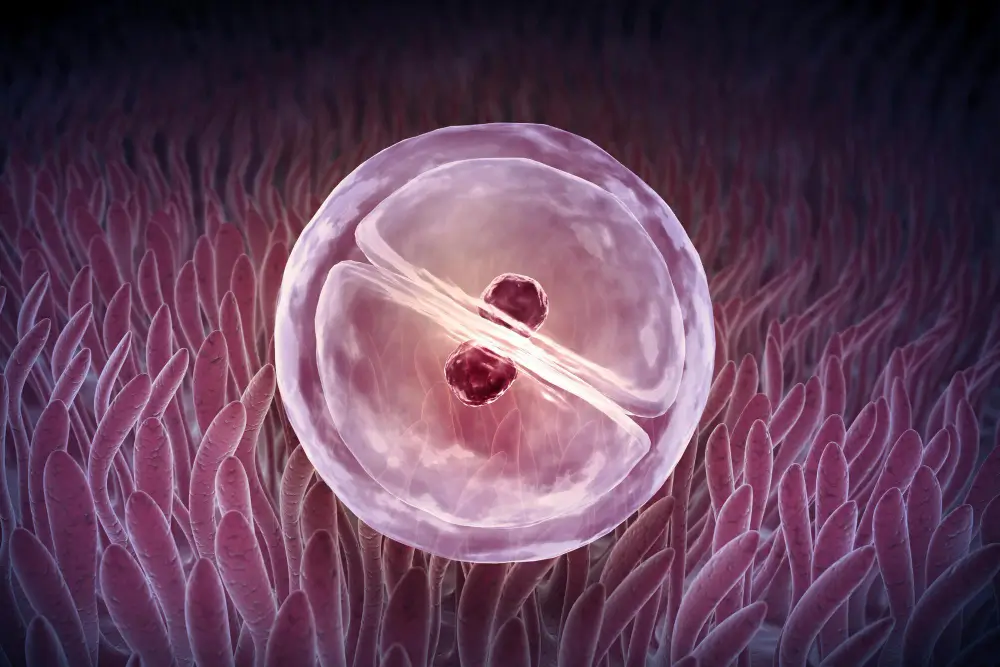
Blastocyst development occurs over the first six days after fertilization. Embryos progress from a single cell (zygote) to cleavage-stage development and ultimately to a fully formed Day-5 or Day-6 blastocyst with distinct internal structures. Understanding this timeline helps intended parents interpret IVF updates and donor-egg cycle outcomes. All embryology work is performed by licensed fertility clinics.
- Day 0: Fertilization
- Day 1–3: Cleavage (2–8 cells)
- Day 4: Morula
- Day 5–6: Blastocyst formation
- EggDonors4All provides education; clinics handle all medical care
Early embryo development is one of the most fascinating—and often confusing—parts of IVF. Intended parents may hear updates such as “Your embryos are compacting” or “Several reached Day-5 blastocyst,” while donors may want to understand how embryos grow after retrieval.
This guide walks through each day of development, explaining how embryos naturally progress and what embryologists observe. The purpose is educational; all laboratory procedures are performed solely by licensed fertility clinics.
EggDonors4All provides donor-matching support, educational guidance, and programs such as Guaranteed Blastocysts—but does not create, culture, or evaluate embryos.
What This Page Covers
- Fertilization through Day-6 development
- Key stages: zygote → cleavage → morula → blastocyst
- How cell structure changes
- Why embryos develop at different speeds
- What embryologists evaluate at each milestone
Day-By-Day Blastocyst Development Timeline
Below is a simplified overview of human embryo development between fertilization and blastocyst formation.
Day 0 — Fertilization (Zygote Stage)
- Sperm enters the egg
- Genetic material combines
- A zygote forms
- Embryologists look for two pronuclei (2PN)
This marks the beginning of embryonic development.
Day 1 — First Cell Division
- The zygote divides into two cells
- Each cell contains identical genetic material
- Early development is closely monitored
Day 2 — Continued Cleavage (2–4 Cells)
- The embryo divides again
- Often reaches 4 cells by the end of Day 2
- Cells should appear similar in size
Embryologists check for fragmentation and symmetry.
Day 3 — Cleavage Stage (6–8 Cells)
- Embryo typically reaches 6–8 cells
- Still considered an early-stage embryo
- No specialized cell types yet
Many clinics provide updates at this stage.
Day 4 — Morula Stage
- Cells begin compaction
- The embryo resembles a mulberry (“morula”)
- Cell boundaries become less visible
- Internal differentiation begins
This stage marks the transition between cleavage and blastocyst formation.
Day 5 — Early or Full Blastocyst
By Day 5, structural specialization becomes visible:
- Inner Cell Mass (ICM) – future fetus
- Trophectoderm (TE) – future placenta
- Blastocoel – fluid-filled cavity
Blastocysts may be:
- Early
- Expanding
- Fully expanded
- Beginning to hatch
Day 6 — Expanding, Hatching, or Fully Hatched Blastocyst
Some embryos reach full blastocyst stage on Day 6 rather than Day 5.
Characteristics include:
- Continued expansion
- Clear structural definition
- Initiation of hatching
- Suitability for freezing or later transfer
Why Embryos Develop at Different Speeds
Embryo development speed varies due to:
- Egg quality
- Sperm factors
- Genetic influences
- Natural biological variation
Slower progression (such as Day-6 blastocyst formation) is not necessarily a sign of poor quality.
How Embryologists Evaluate the Blastocyst Stage
At Day-5 or Day-6, clinics may assess:
- Overall expansion
- ICM visibility
- TE appearance
- Symmetry
- Developmental timing
This evaluation produces grades such as 5AA, 4AB, or 3BB. These grades describe visual structure—not guaranteed outcomes.
Blastocyst Development in Donor-Egg IVF
Donor eggs often show strong developmental patterns due to:
- Younger ovarian age
- Typically healthier egg quality
- Predictable cell division
- Higher blastocyst yield
This can allow intended parents to:
- Plan frozen transfers
- Evaluate multiple blastocysts
- Consider PGT testing
- Coordinate surrogacy timelines
Guaranteed Blastocysts
EggDonors4All provides education and donor coordination only. All embryo creation, culture, testing, freezing, and transfer are performed by licensed fertility clinics.
A Guaranteed Blastocyst Program may be helpful if you want:
- Defined embryo outcomes
- Clarity before committing to transfer
- Structured planning for surrogacy or international IVF
- Reduced uncertainty early in the IVF process
Frequently Asked Questions
Q. Is it normal for some embryos to stop developing before Day-5?
Ans. Yes. Typically, only about 30–50% of fertilized embryos reach the blastocyst stage.
Q. Is a Day-6 blastocyst worse than Day-5?
Ans. No. Once frozen, outcomes are generally comparable.
Q. What does “compaction” mean?
Ans. It refers to cells binding tightly together as the embryo forms a morula.
Q. Can I determine embryo quality from photos?
Ans. No. Proper grading requires trained embryologists and laboratory evaluation.
Q. Does EggDonors4All monitor embryo development?
Ans. No. Clinics perform all medical and laboratory procedures.
Related Blastocyst Topics
- Blastocyst vs Embryo
- Blastocyst Grading
- Day-3 vs Day-5 vs Day-6 Embryos
- Blastocyst Success Rates
- Frozen Blastocysts
- Hatching Blastocysts
- Blastocyst Transfer Guide
- Blastocyst FAQ Library
- Why Families Choose Guaranteed Blastocysts
Want clarity about embryo development or donor-egg IVF?
EggDonors4All provides transparent education, donor matching, and structured embryo-outcome programs like Guaranteed Blastocysts. All embryology is performed at licensed fertility clinics.
- Explore Guaranteed Blastocysts
- Request Donor Information
- Become an Egg Donor
Serving intended parents and donors throughout the USA & Canada.

Dr. Veera Saghar
As an Egg Donor Coordinator, she plays a critical role in our company. Her background as a medical graduate from ISRA UNIVERSITY in Pakistan provides us with a solid foundation in the medical sciences. She has seven years of clinical experience practicing in the USA. This has given her firsthand experience when collaborating with patients and their families.
She is responsible for managing the process of egg donation from start to finish. We identify and screen potential egg donors.
- Dr. Veera Saghar

- Dr. Veera Saghar
- Dr. Veera Saghar
- Dr. Veera Saghar