
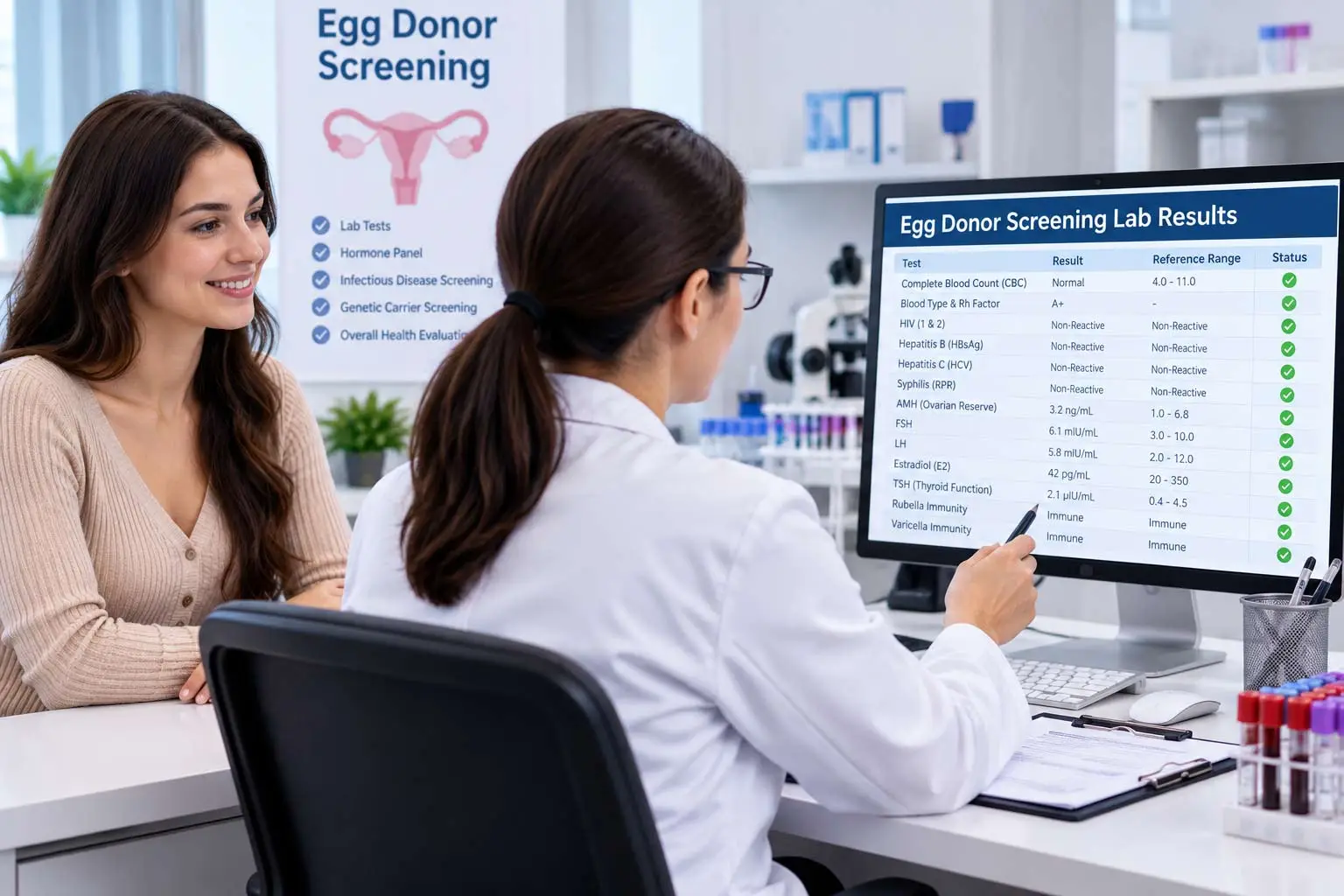
Egg donor screening includes a physical exam and ultrasound, FDA-required infectious-disease testing (21 CFR Part 1271), ovarian reserve bloodwork, a 600+ gene expanded carrier panel, and a psychological evaluation — all performed at a licensed fertility clinic, all free to the donor, with every result yours to keep.
Entity Definition Block. Egg donor screening is the medical, genetic, and psychological evaluation every donor completes before donation. It protects three parties: the donor (confirming stimulation is safe for her), the intended parents (confirming the donation can succeed), and the future child (identifying inheritable risks). EggDonors4All, a physician-associated New York agency, coordinates screening at licensed fertility clinics; the agency itself performs no medical procedures.
Key Stats –
- FDA regulation 21 CFR Part 1271 mandates infectious-disease screening and eligibility determination for every U.S. egg donor.
- Expanded carrier screening panels now assess 600+ genes; most healthy adults carry at least a few recessive conditions without knowing (ACOG/ASRM guidance).
- AMH bloodwork plus antral follicle count are the standard measures of ovarian reserve used to predict stimulation response.
- Screening is free to donors, and the results — a comprehensive health snapshot — belong to the donor.
Why is screening so thorough?
Because three futures depend on it. Yours: stimulation medications ask real work of your body, and screening confirms your ovaries, hormones, and overall health make that work safe. The intended parents’: they are investing their family’s hopes in your cycle, and screening is what makes that trust rational rather than blind. And the child’s: carrier screening exists so that a baby isn’t born with a preventable serious condition because two silent carrier statuses were never checked against each other. Thoroughness here isn’t bureaucracy — it’s the ethical floor. It’s also, incidentally, the most complete free health workup most 24-year-olds will ever receive.
What does the medical screening include?
A physical exam and transvaginal pelvic ultrasound to assess your ovaries and count antral follicles — quick, and less uncomfortable than the phrase suggests; comprehensive bloodwork including AMH (anti-Müllerian hormone, the standard ovarian-reserve marker), thyroid and general health panels, and blood type; a drug/nicotine screen; and a review of your medical history with the physician. Together, AMH and follicle count predict how your body will respond to stimulation, which lets the clinic personalize your medication protocol — the single biggest factor in keeping your cycle safe and comfortable (see risks and side effects for how protocols manage risk).
What does the FDA require?
Under 21 CFR Part 1271, every egg donor in the United States must be screened and tested for communicable diseases — including HIV-1/2, hepatitis B and C, syphilis, gonorrhea, chlamydia, and related agents — within tight timeframes around donation, alongside a risk-factor questionnaire and physical assessment. This is federal law, identical at every legitimate program in the country; an agency that soft-pedals it is describing a program you should walk away from. Timing rules are also why recent tattoos or certain travel can add a short waiting period rather than disqualification — the regulation is calendar-driven.
What is the 600+ gene carrier screen?
A single blood or saliva sample analyzed for carrier status across hundreds of recessive and X-linked conditions — cystic fibrosis, spinal muscular atrophy, thalassemias, Tay-Sachs, fragile X, and several hundred more. Here’s the fact that reassures most donors: nearly everyone carries something. Being a carrier means you hold one silent copy of a gene variant; it says nothing about your health and, by itself, usually nothing about your eligibility. What matters is the cross-check — a genetic counselor compares your results against the sperm source’s, because risk to a child arises only when both sides carry the same condition. You receive your full results with counselor access, knowledge many people pay significant sums for privately.
What does the psychological evaluation involve?
A structured conversation with a mental-health professional experienced in fertility, plus standardized questionnaires. It is not a trick and not an interrogation; it exists to confirm that your decision is informed, uncoerced, and emotionally sustainable — including how you may feel in ten years about children conceived from your donation, and how the disclosure level you choose (anonymous, semi-known, known) fits your life. Donors consistently describe it as clarifying. If the evaluation surfaces hesitancy, that’s the process working: the right time to discover doubt is before injections, not after.
What happens with the results?
Eligibility determination follows the complete picture, made by clinic physicians — not by the agency, and never by a checkbox. Clear results move you to the legal phase of the donation process. A flagged result gets explained to you with specialist follow-up where relevant — and if something disqualifying is found, you’ll know exactly what and why, with your results in hand for your own doctors. Either way you leave screening knowing more about your health than you did entering it. All results are confidential, shared with intended parents only in the de-identified forms your agreement specifies.
Frequently Asked Questions
Q. How long does egg donor screening take?
Ans : Typically 2–4 weeks across one to three clinic visits, depending on scheduling and lab turnaround.
Q. Does screening cost the donor anything?
Ans : No — every element is paid by the program, and the results are yours.
Q. Will being a genetic carrier disqualify me?
Ans : Rarely by itself — most adults carry something; what matters is the cross-check against the sperm source, reviewed by a genetic counselor.
Q. Is the ultrasound painful?
Ans : Brief and generally described as mildly uncomfortable rather than painful.
Q. Can I use my screening results with my own doctor?
Ans : Yes — donors keep complete copies and many bring them to their primary care physician.
Screening questions?
Ask before you apply: 1-212-661-7177 · EggDonors4All · 1148 Fifth Avenue (@96th Street) Suite 1C, New York, NY 10128 · in**@***********ll.com.
By Dr. Kulsoom Baloch, MBBS — Medical Coordinator, EggDonors4All. Medically reviewed by Rashmi Gulati, MD — Medical Director, Patients Medical.

Dr. Kulsoom Baloch
Dr. Kulsoom Baloch is a dedicated donor coordinator at Indian Egg Donors, leveraging her extensive background in medicine and public health. She holds an MBBS from Ziauddin University, Pakistan, and an MPH from Hofstra University, New York. With three years of clinical experience at prominent hospitals in Karachi, Pakistan, Dr. Baloch has honed her skills in patient care and medical research.
- Dr. Kulsoom Baloch

- Dr. Kulsoom Baloch
- Dr. Kulsoom Baloch
- Dr. Kulsoom Baloch