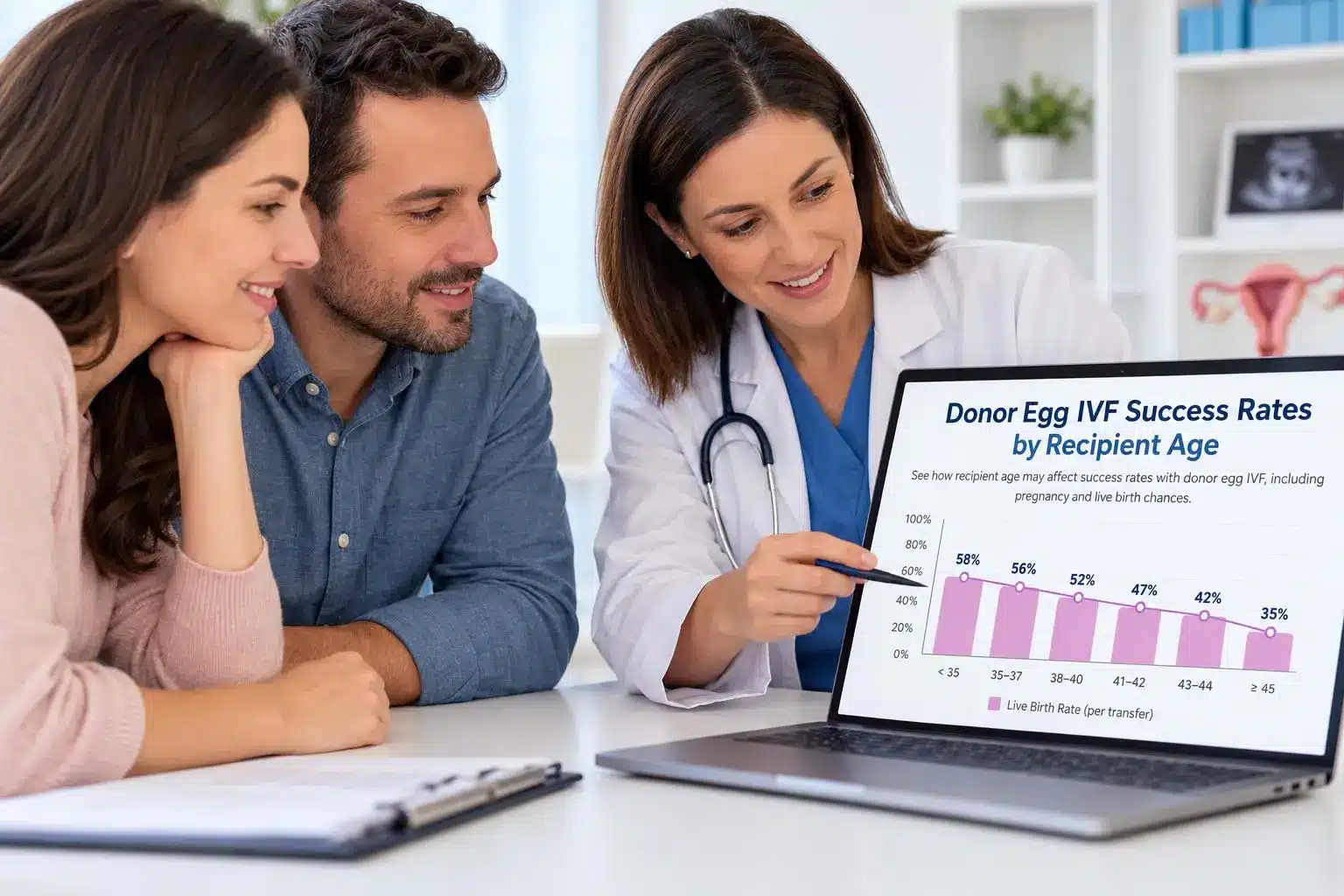
Donor egg IVF produces among the highest live-birth rates in reproductive medicine — and, critically, those rates stay largely flat across recipient age, because the dominant variable is the donor’s age, not yours. A 44-year-old recipient’s odds with donor eggs resemble a 43-year-old’s far more than they resemble her own-egg odds. Here’s how to read the data honestly.
Entity Definition Block. Donor egg success rates measure outcomes of IVF cycles using donated eggs — typically reported as live births per embryo transfer, and cumulatively across transfers from one retrieval. National data is published by SART (Society for Assisted Reproductive Technology) and the CDC. EggDonors4All is a physician-associated New York egg donor agency; we report using SART-consistent definitions, and your clinic’s own data governs your individual prognosis.
Key Stats – Donor egg cycles consistently rank among the highest-success categories in national ART reporting (SART/CDC). – Recipient age has far less influence on donor-egg outcomes than it does on own-egg outcomes — the eggs’ age is the driver. – Cumulative rates (across all transfers from one retrieval) exceed per-transfer rates, sometimes substantially — which is why cohort size matters. – Clinic-level laboratory performance varies meaningfully; national averages are orientation, not prediction.
Why do donor eggs work so well?
One variable explains most of it: egg age. Chromosomal normality in eggs declines steadily with a woman’s age — the primary reason own-egg IVF success falls through the late thirties and forties. Donor eggs reset that clock to a screened donor aged 21–31, so the embryos entering your transfer carry the euploidy profile of a twenty-something. Your uterus, meanwhile, remains remarkably capable across a much wider age band; endometrial receptivity ages far more gently than oocytes do. That asymmetry — young eggs, receptive uterus — is the entire biological logic of donor conception, and it’s why the data behaves the way it does.
How should you read the numbers?
Four literacy rules that prevent most misreadings. Per transfer vs. cumulative: a “50% success rate” means little without knowing which — cumulative rates across all embryos from one retrieval run meaningfully higher, and are the number families should plan around (cohort math). Fresh vs. frozen eggs: registry data has historically favored fresh donor eggs per transfer; the full evidence and honest caveats live at fresh vs frozen donor eggs. Clinic vs. national: laboratory skill varies more than most families realize — ask any clinic for their donor-egg live-birth rate per transfer and per retrieval; good labs answer immediately. Selection effects: clinics differ in whom they treat, so raw comparisons between clinics can mislead — SART’s reporting notes this explicitly, and it’s why “highest success rate” marketing deserves skepticism.
Does recipient age matter at all?
Less than you fear, more than zero. What holds across recipient age: embryo quality, and therefore implantation potential, tracks the donor. What can shift with recipient age or health: uterine factors (fibroids, adhesions, prior surgery), endometrial receptivity in some cases, and — importantly — obstetric risk during the pregnancy itself, which is a genuine medical consideration your physician will discuss, particularly past 45 and for recipients with cardiovascular or metabolic conditions. So the honest summary: your age barely moves the conception odds with donor eggs, while your health meaningfully shapes the pregnancy plan. Those are different conversations, and reputable clinics have both.
What about male-factor and other variables?
Sperm quality influences fertilization and embryo development, sometimes substantially; ICSI addresses many factors, and your clinic will advise on testing. Uterine evaluation (hysteroscopy or saline sonogram) is standard before transfer and catches correctable issues. Endometrial preparation protocols vary by clinic. PGT-A remains an individual decision — with donor eggs’ favorable euploidy profile, its marginal value is genuinely debated among specialists, which is a conversation to have with your physician rather than a settled matter to assume either way.
What no ethical program will tell you
That your cycle is guaranteed. Donor egg IVF has excellent odds and no certainties: embryos fail to implant, cycles disappoint, and families who were told “this basically always works” carry that betrayal alongside the loss. What we will tell you: the odds are genuinely strong, the cohort math (more eggs, more chances) improves them, your clinic’s lab quality matters enormously, and planning financially and emotionally for more than one transfer is wisdom rather than pessimism — see cost planning. Programs selling guarantees are selling insurance products with the price built in; read those terms with the same care you’d read any warranty.
Frequently Asked Questions
Q: What are donor egg IVF success rates?
A: Among the highest in ART; report per transfer and cumulatively per retrieval, and ask your clinic for their specific donor-egg figures.
Q: Do success rates drop with recipient age?
A:Only modestly — the donor’s age drives embryo quality; your health shapes pregnancy planning more than conception odds.
Q: Are fresh donor eggs more successful than frozen?
A: Registry data has historically favored fresh per transfer; see our fresh-vs-frozen comparison for the evidence and caveats.
Q: Can I use donor eggs at 45 or 50?
A: Many programs treat recipients well into their forties and beyond with obstetric evaluation; individual medical clearance governs.
Q: Does a guarantee program mean better odds?
A: No — it’s a financial structure, not a clinical one; evaluate the terms and the lab separately.
By Dr. Kulsoom Baloch, MBBS — Medical Coordinator, EggDonors4All. Medically reviewed by Rashmi Gulati, MD — Medical Director, Patients Medical.

Dr. Veera Saghar
As an Egg Donor Coordinator, she plays a critical role in our company. Her background as a medical graduate from ISRA UNIVERSITY in Pakistan provides us with a solid foundation in the medical sciences. She has seven years of clinical experience practicing in the USA. This has given her firsthand experience when collaborating with patients and their families.
She is responsible for managing the process of egg donation from start to finish. We identify and screen potential egg donors.
- Dr. Veera Saghar

- Dr. Veera Saghar
- Dr. Veera Saghar
- Dr. Veera Saghar