
AI SMART SUMMARY
Approximately 30–50% of fertilized eggs reach the blastocyst stage by Day-5 or Day-6 during IVF. Donor-egg cycles often show higher rates—sometimes 50–70%—because younger eggs tend to divide more predictably.
Blastocyst development depends on genetics, egg age, sperm quality, and laboratory conditions.
EggDonors4All provides education and coordination only. All embryo culture and medical procedures are performed exclusively by licensed fertility clinics.
Key Points:
- IVF average blastocyst rate: 30–50%
- Day-3 to Day-5 conversion rate: 40–60%
- Donor-egg cycles: often 50–70%
- Strong correlation with egg age
- Educational content only (non-medical guidance)
A common question during IVF is how many fertilized eggs will reach the blastocyst stage.
Even in strong donor-egg cycles, not every embryo progresses to Day-5 or Day-6. Understanding expected blastocyst percentages helps families set realistic expectations, plan financially, and prepare emotionally for next steps.
EggDonors4All supports intended parents with donor matching and educational guidance. All fertilization, embryo culture, genetic testing, freezing, and transfer procedures are handled solely by licensed fertility clinics.
Average Percentage of Fertilized Eggs That Reach Blastocyst
Across IVF globally, approximately:
30–50% of fertilized eggs reach the blastocyst stage.
For example:
- 10 fertilized eggs may result in 3–5 blastocysts
- Some embryos may reach Day-3 but not continue to Day-5
- Others may stop dividing earlier
Blastocyst development reflects natural biological selection—not clinic performance.
Day-3 to Day-5 Conversion Rate
A commonly referenced IVF benchmark shows:
40–60% of Day-3 embryos progress to blastocyst.
Actual rates depend on:
- Egg age
- Embryo genetics
- Sperm quality
- Laboratory environment
This level of variation is normal and expected.
Blastocyst Development Rates in Donor-Egg IVF
Younger eggs typically:
- Divide more consistently
- Have fewer chromosomal abnormalities
- Reach blastocyst at higher rates
As a result:
Donor-egg cycles often achieve 50–70% blastocyst development.
This can provide:
- More embryos available for freezing
- Additional options for genetic testing
- Greater flexibility for surrogacy or future sibling planning
How Egg Donor Age Affects Blastocyst Development (Extended to Age 45)
Egg age is one of the strongest predictors of blastocyst formation.
As egg age increases:
- Chromosomal stability declines
- Mitochondrial energy production decreases
- Cell division patterns become less predictable
Below is an illustrative model showing typical developmental trends from age 20 to 45.
Extended Table: Egg Age vs. Percentage Reaching Blastocyst
| Egg Age | % Reaching Blastocyst (Illustrative) |
|---|---|
| 20 | 65% |
| 22 | 63% |
| 24 | 60% |
| 26 | 57% |
| 28 | 53% |
| 30 | 48% |
| 32 | 40% |
| 34 | 30% |
| 36 | 25% |
| 38 | 20% |
| 40 | 15% |
| 42 | 10% |
| 45 | 5% |
Interpretation
- Development rates remain strong throughout the 20s.
- A noticeable decline begins after age 32.
- Over age 40, relatively few embryos reach blastocyst.
- By age 45, blastocyst formation is rare.
For this reason, most egg donor programs limit donor age to under 30 to optimize embryo development potential.
Graph: Donor Age vs Blastocyst Development Rate (20–45)
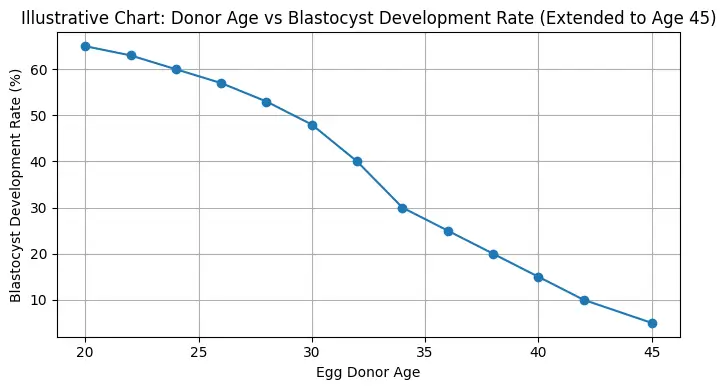
Figure: Illustrative model showing the decline in blastocyst development rate with increasing egg age. Actual results vary by clinic, biology, and embryo genetics.
Why Don’t All Embryos Reach Blastocyst?
Not every fertilized egg develops into a Day-5 or Day-6 blastocyst. This is normal biology—not a failure of treatment.
Common biological factors include:
- Chromosomal differences Most early embryo arrest is due to genetic abnormalities present at fertilization.
- Sperm quality DNA fragmentation or structural issues can affect cleavage and morula formation.
- Natural biological variation Even high-quality eggs can produce embryos that stop dividing.
- Energy availability (mitochondria) Egg age influences mitochondrial strength, which powers early cell division.
- Differences in development speed Some embryos develop more slowly. Day-6 blastocysts are completely normal.
Embryo attrition happens in IVF and also in natural conception. It is part of normal reproductive biology.
Is a Higher Blastocyst Rate Always Better?
Not necessarily.
Sometimes one high-quality blastocyst is all that’s needed for a successful pregnancy.
However, having more blastocysts can provide:
- More transfer opportunities
- More embryos available for PGT-A testing
- Greater flexibility for surrogacy planning
- Future sibling options
Blastocyst numbers support planning—but they do not guarantee outcomes.
Why This Percentage Matters for IVF Planning
Understanding blastocyst probabilities helps families:
- Set realistic expectations: 10 eggs ≠ 10 embryos ≠ 10 blastocysts.
- Understand donor-egg advantages: Younger eggs often produce higher embryo yield.
- Plan long-term family goals: More blastocysts may support future transfers.
- Evaluate structured programs: Defined embryo outcomes can reduce early IVF uncertainty.
Guaranteed Blastocysts (Educational Overview)
Some intended parents prefer clearer embryo expectations rather than waiting through uncertain development stages.
Guaranteed Blastocyst Programs typically provide:
- A defined minimum number of blastocysts
- Reduced emotional and financial unpredictability
- Easier coordination for surrogacy
- More clarity before transfer planning
EggDonors4All provides coordination and educational support, while all embryo culture, fertilization, grading, testing, and transfer procedures are performed exclusively by licensed fertility clinics.
Frequently Asked Questions
Q. Is 30–50% blastocyst development normal?
Ans. Yes. This is the typical IVF average worldwide.
Q. Why do donor eggs have higher blastocyst rates?
Ans. Younger eggs tend to have fewer chromosomal abnormalities and stronger cellular energy.
Q. Are Day-6 blastocysts viable?
Ans. Yes. Day-6 embryos perform similarly to Day-5 embryos in frozen transfers.
Q. Does every fertilized egg become a blastocyst?
Ans. No. Embryo attrition is expected and biologically normal.
Q. Does EggDonors4All influence embryo development?
Ans. No. All laboratory and medical processes are handled by licensed fertility clinics.
Need clarity about how many blastocysts to expect in your IVF journey?
EggDonors4All provides donor selection support, educational guidance, and structured embryo-outcome programs such as Guaranteed Blastocysts—while licensed fertility clinics manage all medical procedures.
- Explore Guaranteed Blastocysts
- Request Donor Information
- Become an Egg Donor

Dr. Veera Saghar
As an Egg Donor Coordinator, she plays a critical role in our company. Her background as a medical graduate from ISRA UNIVERSITY in Pakistan provides us with a solid foundation in the medical sciences. She has seven years of clinical experience practicing in the USA. This has given her firsthand experience when collaborating with patients and their families.
She is responsible for managing the process of egg donation from start to finish. We identify and screen potential egg donors.
- Dr. Veera Saghar

- Dr. Veera Saghar
- Dr. Veera Saghar
- Dr. Veera Saghar