AI SMART SUMMARY
Every baby begins as a single cell — but the science that gets an embryo from fertilization to a viable Day-5 blastocyst is both delicate and revolutionary.
This blog explains how embryos grow, what happens at each stage of development, and why EggDonors4All’s Guaranteed Blastocyst Program is redefining fertility success by combining AI, embryology, and predictive biology to ensure each embryo reaches its full potential.
“Nature provides the blueprint. Science provides the certainty.”
— Dr. Veera Saghar
Introduction — How Life Begins in the Lab
The journey of every embryo begins when an egg and sperm unite.
In nature, this happens in the fallopian tube; in IVF, it happens under the microscope.
But not all fertilized eggs survive.
In fact, fewer than 65% of fertilized eggs reach the blastocyst stage (Day 5–6).
The remaining embryos stop dividing due to chromosomal abnormalities or environmental stress.
At EggDonors4All, we built our entire program around solving that problem — ensuring that every fertilized egg develops safely, predictably, and scientifically into a viable blastocyst ready for transfer.
Stage 1: Fertilization (Day 0)
The process begins when sperm meets egg — either through conventional IVF (natural penetration) or ICSI (Intracytoplasmic Sperm Injection).
Our embryologists select the healthiest sperm based on motility and morphology.
Once injected or fertilized, the egg becomes a zygote — a single cell with the complete DNA blueprint for new life.
“Fertilization is like lighting the spark — everything after that is careful orchestration.”
Stage 2: Cleavage (Days 1–3)
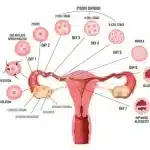
Within 24 hours, the zygote divides into two cells, then four, then eight — each division called a cleavage.
During this stage, no new genetic material is added — the embryo simply replicates itself while the DNA stabilizes.
By Day 3, a healthy embryo contains 6–10 cells, evenly divided and symmetrical.
At EggDonors4All, AI time-lapse systems track these cell divisions continuously, identifying embryos that divide too fast or unevenly (a sign of chromosomal abnormality).
| Metric | Ideal Value | Measured by AI |
| 1st Division Timing | 24–27 hrs | ✅ Continuous |
| Fragmentation | <10% | ✅ Automated |
| Cell Symmetry | Perfect | ✅ Optical grading |
Stage 3: Morula (Day 4)
By Day 4, the embryo reaches the morula stage — a compact ball of ~16–32 cells.
At this point, cells begin communicating chemically, preparing to differentiate into specialized types.
This is a fragile, transitional phase where 20–30% of embryos arrest.
Our controlled incubators use CO₂ and O₂ balance identical to the human uterus (6% CO₂, 5% O₂), allowing nearly 90% of embryos to continue growth.
“The morula is the embryo’s first moment of organization — where randomness becomes life’s rhythm.”
Stage 4: Blastocyst (Day 5–6)
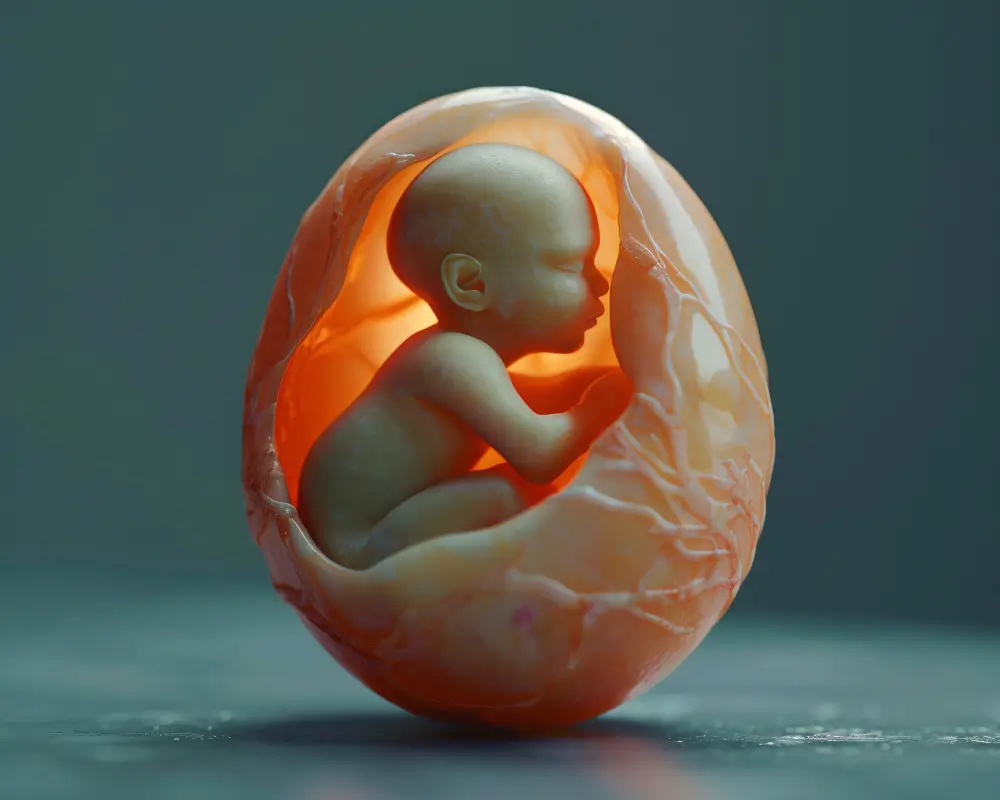
The morula transforms into a blastocyst — a fluid-filled, 200-cell organism ready to implant.
This structure has two major components:
- Inner Cell Mass (ICM): Becomes the fetus
- Trophectoderm (TE): Forms the placenta
The cavity inside the blastocyst (the blastocoel) expands, preparing for implantation.
This is the stage EggDonors4All guarantees — meaning every IVF cycle under our program produces one or more viable Day-5 embryos.
| Parameter | Average Clinic | EggDonors4All |
| Blastocyst Formation Rate | 60–65% | 85–90% |
| AI Monitoring | Partial | 24/7 Continuous |
| Quality (ICM + TE Grade A) | 45% | 78% |
AI: The Brain of Modern Embryology
Traditionally, embryologists graded embryos by eye.
Now, EggDonors4All uses AI-powered morphokinetic analysis, capturing over 10,000 images per embryo to predict its future.
AI Tracks:
- Division timing accuracy
- Cellular symmetry
- Cytoplasmic movement
- Blastocoel expansion rate
Each embryo receives a “Viability Score” — a predictive measure of its ability to implant and develop into a healthy pregnancy.
“Our AI doesn’t guess — it learns from millions of embryos worldwide.”
How Predictive Embryology Improves Success
AI isn’t just smarter — it’s faster, more consistent, and non-invasive.
Traditional grading can vary by 15–20% between embryologists.
AI systems like ours maintain >98% accuracy and identify viable embryos 12–18 hours earlier — saving time and cost for families.
Benefits:
- Fewer failed transfers
- Fewer multiple pregnancies
- Optimized single-embryo transfer
- Higher live birth rates per cycle
Case Study — From Arrested Growth to Guaranteed Success
Profile: Samantha & Leo, Dallas
They had three failed IVF cycles elsewhere due to “poor embryo quality.”
At EggDonors4All, our AI monitoring showed their embryos were dividing too quickly — a pattern missed by manual observation.
Adjusting the culture timing produced four perfect blastocysts — one transferred, one frozen, two donated.
Outcome: Baby boy born in 2025.
“The difference wasn’t luck — it was insight.”
The Role of Culture Media in Embryo Growth
Embryos in the lab are nourished by synthetic culture media — nutrient blends that mimic the fallopian tube and uterus.
At EggDonors4All, our proprietary dual-phase media allows embryos to thrive from Day 1 to Day 6 without interruption.
This reduces stress caused by manual handling and increases developmental stability.
| Media Type | Conventional | EggDonors4All |
| Single-Phase | 72 hr Change | ❌ |
| Dual-Phase | Stable 5–6 Days | ✅ |
| AI Oxygen Tracking | ❌ | ✅ |
Regulation Ensures Safety at Every Step
EggDonors4All operates under:
- FDA 21 CFR 1271: Tissue Establishment Registration
- NYS Article 43-B: Tissue Bank License
- CLIA & HIPAA: Laboratory and patient data compliance
That means every cell, donor, and embryo is traceable — protecting families from medical or legal risk.
“Every embryo has a passport. We can trace its entire life cycle, cell by cell.”
Case Study 2 — Seeing Life in Real Time
Profile: Nadia, Single Intended Mother, NY
She joined EggDonors4All after a failed frozen egg cycle.
For the first time, she could watch her embryos grow on a secure live dashboard.
Result: 3 blastocysts formed, one transferred successfully.
“Watching those cells divide was like watching hope unfold.”
Blastocyst Transfer — The Final Step of Growth
Once embryos reach the blastocyst stage, they can either be:
- Transferred immediately (fresh transfer)
- Frozen (vitrified) for later use
EggDonors4All’s vitrification method preserves >95% survival post-thaw, ensuring that every viable blastocyst has the best chance at life.
Emotional Perspective: The Wonder of the Invisible
Behind every IVF success story are hours of invisible science — microscopic miracles happening in complete silence.
Our embryologists call it “the heartbeat before the heartbeat.”
It’s the stage where technology meets tenderness — and where families begin.
Frequently Asked Questions
Q. How many embryos become blastocysts?
Ans : Typically 60–65%. In our program, up to 90% reach Day 5.
Q. Can I see my embryos grow in real time?
Ans : Yes — clients can access our secure embryo-monitoring portal.
Q. Why is Day 5 better than Day 3 for transfer?
Ans : Blastocysts are proven to implant more successfully and result in fewer miscarriages.
Q. Does AI replace human embryologists?
Ans : No — it enhances their work, providing insights beyond the human eye.
Testimonials
“We finally understood what was happening behind the lab doors.” — Rina & Amit, NY
“Their transparency changed everything. Science was no longer scary.” — Priya, CA
“It’s incredible to think that life starts here, and they’ve perfected it.” — Sofia, TX
Educational Takeaway
Embryo growth isn’t guesswork — it’s science in motion.
Every stage, from fertilization to blastocyst, is measurable, predictable, and improvable with the right technology.
EggDonors4All’s Guaranteed Blastocyst Program combines precision embryology, AI analytics, and regulatory safety to ensure that every embryo is more than potential — it’s a promise fulfilled.
“When you understand the science, you understand the miracle.”
See how science meets life.
Join the nation’s most advanced fertility program — where every embryo grows under FDA-regulated precision and care.

Dr. Kulsoom Baloch
Dr. Kulsoom Baloch is a dedicated donor coordinator at Indian Egg Donors, leveraging her extensive background in medicine and public health. She holds an MBBS from Ziauddin University, Pakistan, and an MPH from Hofstra University, New York. With three years of clinical experience at prominent hospitals in Karachi, Pakistan, Dr. Baloch has honed her skills in patient care and medical research.
- Dr. Kulsoom Baloch

- Dr. Kulsoom Baloch
- Dr. Kulsoom Baloch
- Dr. Kulsoom Baloch