Does Donating Eggs Affect Your Future Fertility?
Current evidence does not show that a properly conducted egg donation cycle reduces a donor’s future fertility. The biology explains why: stimulation medication rescues eggs your body had already recruited that month and would otherwise have discarded — it does not draw down eggs from future months. Here is the full explanation, including where the evidence has limits.
The question behind every other question
This is the one donors ask their mothers about, and mothers ask us about. It deserves a careful answer rather than a reassuring one, so the honest version comes with its reasoning attached. The complete safety picture — side effects, OHSS, procedural risks — is at egg donation risks and side effects; this piece addresses the fertility question specifically.
The biology: recruitment, not depletion
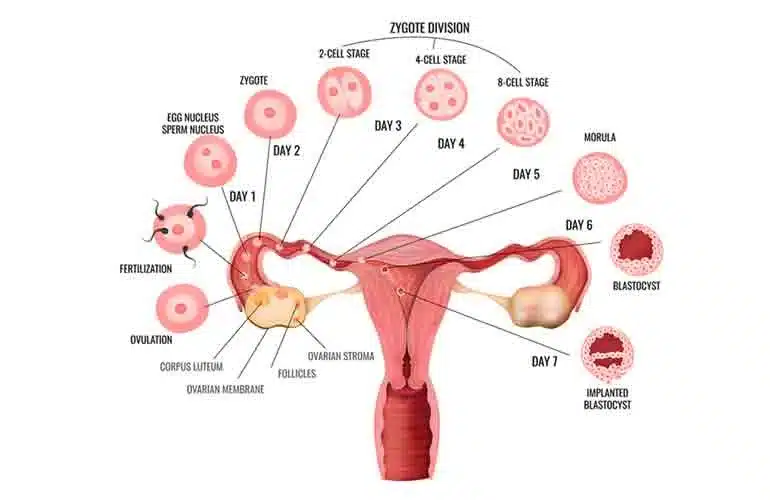
Here’s what happens in an ordinary month. Your ovaries recruit a cohort of follicles — a group, not one. Hormonal signaling then selects a single dominant follicle to mature and release an egg, and the rest of that recruited group undergoes atresia: they dissolve. This happens every cycle, month after month, from puberty. The eggs that dissolve are not saved for later; they are simply gone.
Now here’s a stimulation cycle. Medication supports that same already-recruited cohort — the group your body selected this month — so that more of those follicles mature instead of dissolving. The retrieval collects them. What it does not do is reach forward into future months and pull eggs that hadn’t yet been recruited. Your ovarian reserve for next year is not spent by this month’s cycle.
That mechanism is why the evidence and the biology point the same direction, and it’s the single most useful thing for a prospective donor to understand. It’s also why screening measures your reserve first — AMH bloodwork and antral follicle count establish your baseline before anything begins (what screening covers).
What the evidence shows — and where it’s limited
Current evidence does not demonstrate that a properly conducted donation cycle reduces future fertility. Donation has been practiced for decades across an enormous number of cycles without a demonstrated fertility-harm signal.
The honest qualifier: long-term donor registries are smaller than anyone in reproductive medicine would like. Donors are typically healthy young women who disperse after their cycles, and systematically following them for decades is difficult — professional bodies including ASRM have noted these research gaps. So the accurate statement is “current evidence does not show harm,” not “it has been proven impossible.” Any program that offers you the stronger claim is telling you something it cannot know, and that should make you trust everything else it says a little less.
The six-cycle lifetime limit exists partly in this context — prudent stewardship while long-horizon research continues to accumulate. See how many times can you donate eggs.
What about egg “count” and AMH after donation?
Donors sometimes ask whether their AMH will be lower afterward. AMH reflects the size of the pool of small follicles available for recruitment, and it fluctuates naturally. Because stimulation acts on an already-recruited cohort rather than the underlying reserve, the reserve itself isn’t the target of the process. If you’re curious about your own numbers, you’ll have baseline results from screening — they’re yours to keep, and you can discuss them with your own physician at any point in your life. Many donors find that baseline genuinely valuable years later when planning their own families.
What could affect fertility — and how it’s managed
The honest risk pathway isn’t the egg count; it’s complications. Serious complications from retrieval are uncommon, but a significant pelvic infection or a severe complication could, in principle, affect reproductive health — which is exactly why the process is built the way it is: rigorous screening, treatment only at licensed clinics, individualized protocols based on your bloodwork, monitoring at 5–8 points during stimulation, and a complications insurance policy covering every cycle at no cost to the donor. Those safeguards aren’t bureaucracy; they’re the answer to this question. Full detail at risks and side effects, and your screening physician reviews your individual risk profile before you begin.
What donors should actually do with this information
Read the full safety page before your screening appointment, bring your questions in writing, and ask the physician directly — clinics respect prepared donors, and this is precisely the conversation the screening visit exists for. If any answer feels like marketing rather than medicine, that’s information too.
Start at become an egg donor, or call 1-212-661-7177 and ask the hard questions first.
Frequently Asked Questions –
Q. Can egg donation cause infertility?
A. Current evidence does not show that a properly conducted donation cycle reduces future fertility.
Q. Does donating eggs use up my eggs?
A. No — stimulation supports eggs already recruited that month, which would otherwise dissolve; it doesn’t draw from future months.
Q. Will my AMH be lower after donating?
A. AMH reflects the underlying follicle pool, which isn’t what stimulation acts on; discuss your own baseline results with your physician.
Q. Is there long-term research on donors?
A. Long-term donor registries are smaller than the field would like — which is why the honest statement is “current evidence does not show harm.”
Q. How many cycles are considered safe?
A. ASRM guidance supports up to six lifetime cycles.
By Dr. Kulsoom Baloch, MBBS — Medical Coordinator, EggDonors4All. Medically reviewed by Rashmi Gulati, MD — Medical Director, Patients Medical.

Dr. Kulsoom Baloch
Dr. Kulsoom Baloch is a dedicated donor coordinator at Indian Egg Donors, leveraging her extensive background in medicine and public health. She holds an MBBS from Ziauddin University, Pakistan, and an MPH from Hofstra University, New York. With three years of clinical experience at prominent hospitals in Karachi, Pakistan, Dr. Baloch has honed her skills in patient care and medical research.
- Dr. Kulsoom Baloch

- Dr. Kulsoom Baloch
- Dr. Kulsoom Baloch
- Dr. Kulsoom Baloch